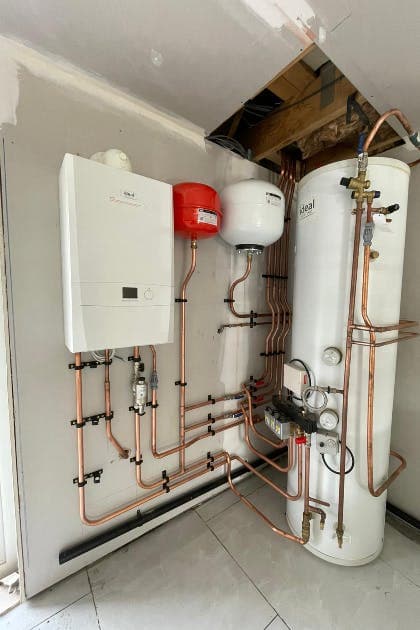
The signs that point to a repair or a new boiler, and the checks you can safely make first.
Blog
Should I repair or replace my old boiler?
GGS Heating

If your boiler is getting older and has started to let you down, whether to repair it or replace it comes down to three things: its age, how often it breaks down, and whether it can still be kept running safely. A one-off fault on a boiler under ten years old is usually worth repairing. Repeated breakdowns on a boiler of 15 years or more, especially one fitted before 2005, usually point towards a replacement.
This post covers the signs that point each way, what you can safely check yourself, and what a heating engineer looks at before giving advice. You can look at the pressure gauge, the label on the boiler and your paperwork, but never remove the boiler casing or touch any gas parts yourself.
When a repair makes sense
Most boiler faults come down to one worn part, such as a pump, fan or valve. If your boiler is under ten years old, has been serviced regularly and this is the first real problem it has had, a repair is nearly always the sensible choice.
A repair also makes sense when the part is easy to get hold of and the rest of the boiler is in good condition. A heating engineer can tell you this once they have found the cause, so you are not guessing.
If you are not sure what the fault is yet, our boiler repair service starts with finding the cause and explaining your options before any work begins.
Signs it may be time to replace your boiler
The more of these that apply, the stronger the case for a new boiler:
It is breaking down more often. Two or three call-outs in a year usually means more parts are wearing out, not just one.
Parts are hard to find. Manufacturers stop making parts for older models, so repairs take longer and cost more.
It is a non-condensing boiler. A condensing boiler reuses heat from its own waste gases, so less heat goes out of the flue. Condensing boilers became mandatory for new installations in April 2005, so a boiler fitted before then is likely to be the older, less efficient type.
Your gas bills keep rising even though you use the heating the same way.
It has been found unsafe. If an engineer labels an appliance "Danger Do Not Use", it must not be used until it is put right. On an old boiler, the repair may not be worth it.
Your needs have changed, such as a new bathroom or more people in the house needing hot water at once.
Safe checks you can make at home
A few simple checks will help you decide, and help the engineer:
Find the boiler's age. Look for the data label, often under the boiler or behind the front flap that covers the controls. The flap opens by hand, with no tools. The model name and serial number on it tell an engineer roughly when it was made.
Look at your paperwork. When a new boiler is fitted by a Gas Safe registered installer, you should receive a Building Regulations Compliance Certificate, which records when it went in.
Count the call-outs. Note how many times the boiler has failed in the last two years, and what was done.
Check the pressure gauge. If the pressure keeps dropping, note how quickly. Our post on what boiler noises can mean covers other warning signs worth writing down.
If you ever smell gas, turn the appliance off, open windows and call the National Gas Emergency number on 0800 111 999.
Why hard water matters in this part of Lincolnshire
Anglian Water, which supplies Louth, classes the water across its region as hard to very hard. Hard water carries minerals that leave limescale behind when it is heated.
Over the years, limescale can build up inside a boiler's heat exchanger, the part that passes heat from the burner into your water. This makes it noisier and less efficient, and strains its parts. On an older boiler that has never had its system cleaned or protected, this wear is one reason faults start to come closer together.
What we look at before giving advice
When we visit, a Gas Safe registered engineer checks how the boiler is burning, the system pressure and the controls, and tests the parts that are likely to have failed. We explain what we have found and what each option involves before any work starts.
Sometimes the answer is a simple repair and a regular boiler service to keep it running well. Sometimes it is fairer to tell you that a repair would only buy a few months. Either way, the choice is yours.
What replacing a boiler involves
If replacement is the better option, the first step is a survey. The engineer looks at your pipework, where the flue can go and how much heat and hot water your home needs, then recommends a boiler type. We fit combi, system and conventional boilers, and we hold installer accreditations with Baxi, Ideal and Worcester Bosch.
On the day, the old boiler is removed, the new one is fitted and it is commissioned. Commissioning means the final checks and settings that confirm it is running safely and efficiently. A straight swap for a similar boiler in the same place is the quickest kind of job. Moving the boiler or changing its type takes longer.
Afterwards, keep your Building Regulations Compliance Certificate safe, as you may need it when you sell your home.
What affects the cost either way
For a repair, the cost mainly depends on the part needed and whether it is readily available. For a replacement, it depends on the type of boiler, whether it stays in the same place, any changes to the flue or pipework, the controls you choose and whether the system needs cleaning first. A survey gives you a written quote, so you can compare it fairly with keeping the old boiler going.
Autumn is a good time to make this decision. A boiler that is struggling now is more likely to fail in the first cold spell, when engineers are busiest.
If your boiler is getting older and you are not sure whether it is worth repairing, GGS Heating can take a look and give you a clear answer. Book a visit through our boiler installation page to arrange a survey, or ask us to diagnose the fault first.
Other Articles